Construction method of underground storage tanks at gas stations
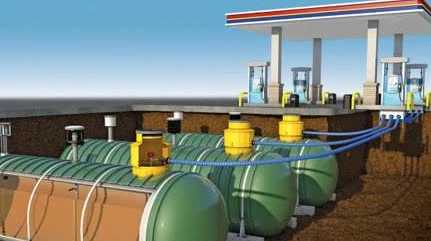
Construction method and requirements of buried oil tanks at gas stations. Buried oil tanks are the main equipment for storing oil at gas stations.
1. Excavation of the slope of underground oil storage tanks. The excavator digs the soil, and after digging, a drainage ditch is built around it, and a north-south blind ditch and a water collection well are built in the middle. The water outside the foundation pit is pumped out with a water pump. When excavating, old soil, such as dark banks and quicksand, should be excavated and solved as soon as possible.
2. Tank pool cushion. Backfill with medium-coarse sand, the cushion height is 30cm, and the oil tank is hoisted after the bottom sand filling layer of the oil tank is leveled.
3. Oil tank hoisting. According to the on-site operation conditions, underground oil tank hoisting tools are selected. Before hoisting, the appearance quality and external anti-corrosion of the buried oil tank are inspected and accepted. Before lifting, check the position of the crane's outriggers and wire ropes, and then lift.
4. Backfilling of the oil tank pool and filling of the oil tank with water.
(1) After the lifting is completed, the oil tank is filled with water and the groundwater level is monitored. The scaffolding steel pipe is used to fix it to prevent the oil tank from floating up or shifting during backfilling. Note that the water level in the tank pool must not exceed the water level in the tank;
(2) Backfilling sand: backfill sand around the tank body and backfill soil in other parts. Stones cannot directly contact the tank body to avoid damaging the anti-corrosion layer outside the tank.
5. Surface layer construction
Technical requirements for buried oil tank construction at gas stations
Buried oil tanks at gas stations must comply with standards and meet requirements.
1. Oil storage medium in the tank: diesel, gasoline, ethanol gasoline, etc. Since oil is a flammable medium, a flame arrester is installed at the outlet of the exhaust pipe to prevent the fire source from entering the oil tank;
2. Design pressure normal pressure, temperature <50 C
3. Burial depth 0.5m, corrosion allowance 1mm, oil tank material Q235-B, pressure test 0.1MPa;
4. 4 full volume specifications: 20m3, 30m3, 50m3, 50m3 (compartment type), filling coefficient 0.9;
5. Cylinder inner diameter: 20m3 tank inner diameter 2200 mm, 30m3 tank inner diameter 2400 mm, 50m3 tank inner diameter 2800 mm;
6. The oil tank is prevented from floating by anti-floating belts and fixed saddles.
7. The tank is equipped with lifting ears for easy loading and unloading. The welding specifications of the two conductive static grounding galvanized flat steels are ━40×4, which is convenient for connection with the static grounding network;
8. Manhole diameter: 2 DN600 inspection holes, the manhole flange is a machined standard plate flat welded steel flange, the manhole neck height is 200mm, the manhole cover and flange thickness are ≥22mm, the oil-resistant rubber asbestos flange gasket, bolts, nuts and washers are in accordance with national standards. A water retaining plate is provided at the inspection hole;
9. The buried oil tank environment is humid, and filling soil and sand will corrode the tank wall. It is necessary to sandblast and remove rust, and use reinforced epoxy coal tar paint for anti-corrosion treatment to extend the life of the tank;
10. Pipe specifications: oil inlet φ89×4mm, oil outlet φ89×4 or φ133×5mm, vent φ57×3.5mm, oil measuring hole φ108×4mm, liquid level gauge port φ108×4mm, manhole φ630×6mm;
11. Oil tank wall thickness: 20, 30 cubic meter oil tank barrel wall thickness 6mm, cylinder head wall thickness 8mm, 50 cubic meter oil tank barrel wall thickness 8mm, cylinder head wall thickness 10mm. The welding coefficient is 0.85;
12. Arc welding, manual welding electrode brand J422, automatic welding electrode brand H08A, flux brand HJ431. Weld seam inspection standard JB/T4730.2 radiographic inspection, inspection length 10%, fillet weld inspection standard JB/T4730;
13. Underground oil tanks must be equipped with separate breathing tubes (pipe diameter should not be less than 50 mm) and flame arresters, and the distance between the pipe mouth and the ground should be no less than 4 meters. The breathing tube set upward along the wall of the building must have a pipe mouth 1 meter higher than the building and a net distance of no less than 3 meters from the doors and windows. Avoid the introduction of external fire sources into the oil tank. The gas space of the buried oil tank at the gas station has no obvious temperature change during the day and night, and no small breathing occurs. The installation of a breathing valve will increase the resistance to oil unloading and prolong the oil unloading time.
Operators must work strictly in accordance with the operating procedures, do a good job in safe construction, and ensure the smooth progress of construction operations.