
Summary of Requirements
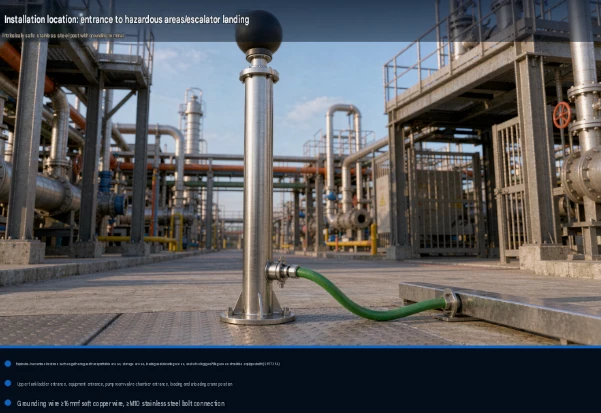
Installation Location:Must be installed in areas with explosion hazards, such as oil and gas gathering, processing/purification, refining, storage, transportation, loading/unloading, and refueling/gas-filling facilities (e.g., at tank stairway entrances, unit entrances, pump room/valve station doorways, and loading/unloading bays).
Connection Method: Grounding wire connecting the support's grounding terminal to the main grounding bus (or a grounding conductor like the tank body): ≥16 mm² flexible copper wire; copper grounding terminals crimped at both ends; secured with ≥M10 stainless steel bolts and anti-loosening washers.
Compliance Standards: Grounding resistance ≤100 Ω; surface resistance of the touch element: 1×10⁷ Ω to 1×10⁹ Ω; charge transfer ≤0.1 μC.
Usage:Touch with bare hands for at least 1 second.
Testing Frequency:Every six months (static discharge performance test for each unit; conducted alongside lightning and static protection inspections, at least semi-annually).
Test Parameters:Support grounding resistance, touch element surface resistance, charge transfer, and on-site grounding resistance.
Testing Entity:Must be conducted by a qualified testing agency; equipment may only be used on-site after passing inspection.
No. | Name of Hazardous Area | Installation Location
1 | Combustible liquid storage tanks (including various oil tanks, oily wastewater tanks, etc.) | At the top of the tank access ladder; 1.5 m from the gauging hatch on the tank roof
2 | Combustible gas storage tanks (spherical tanks, horizontal tanks, etc.) | At the top of the tank access ladder
3 | Combustible liquid/gas production unit areas | At the unit entrance; 1.5 m from combustible gas/liquid sampling points
4 | Combustible liquid/gas pump houses and valve stations | At the entrance to the pump house or valve station
5 | Natural gas compressor buildings | At the building entrance
6 | Buildings containing combustible gas/liquid process piping, valves, vessels, or equipment | At the building entrance
7 | Waste oil pits | At the pit entrance
8 | Fueling and gas-filling stations | 1.5 m from the unloading inlet; on the casing of self-service fuel dispensers
9 | Combustible liquid loading/unloading platforms | At the platform ladder entrance; at the platform gangway entrance
10 | Combustible gas loading/unloading platforms | At each loading/unloading arm station
The grounding conductor connecting the grounding terminal of the support structure to the grounding main line or grounding conductor (such as a tank body or metal framework) should preferably be a flexible copper wire with a cross-sectional area of at least 16 mm²; copper cable lugs should be welded to both ends, and the connection should be made using stainless steel bolts (size M10 or larger) equipped with stainless steel anti-loosening washers.


