
What's underground at a gas station? Why does gasoline flow continuously?
The gas stations we see in everyday life are just surface buildings, and nothing about them seems extraordinary. However, the real core of a gas station is actually buried underground. Gas stations have many underground storage tanks, which are the heart of the entire station.
As for the tanks themselves, the materials must be strong enough. In China, most of the underground storage tanks at gas stations are made of double-layer welded carbon steel. These tanks prevent gasoline and diesel from leaking and also have extremely high strength. Gas stations in China are divided into three levels, and the storage tank sizes vary according to the level. A first-level tank typically has a standard capacity of 50 cubic meters, and a gas station may have up to three of these tanks. These tanks can store about 150,000 liters of gasoline, which is enough to provide fueling services to 3,000 cars daily. Underground storage tanks generally have three valves: the fuel delivery valve, the vent valve, and the sensor valve.
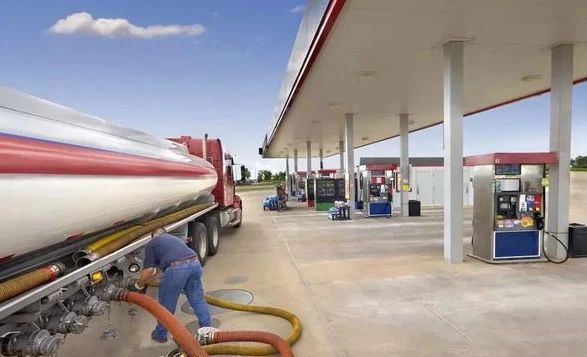
The fuel delivery valve, as the name suggests, is where gasoline enters and exits. When we refuel, the fuel pump draws gasoline from here. The flow rate of the gasoline through the pipes is fixed, so the ground control system can calculate the amount of fuel dispensed, and this data is uploaded to the terminal display screen. The same delivery pipe is also used for refueling the tanks when oil tankers deliver fuel. The vent valve's job is to release the gases from inside the storage tank. You might wonder why there are gases in the tank when it stores liquid fuel like gasoline and diesel. Actually, the gases are formed from the evaporation of these fuels.
Diesel is not very volatile, so the diesel tanks don't need frequent venting. However, gasoline is much more volatile, which is why a vent valve is necessary. This vent valve is also known as a safety valve. It has a simple structure: at the valve opening, there is a small ball. When the ball is near the valve, it stays closed; when it moves away, the valve opens to vent the gases. Normally, this vent valve is not in use, and it only activates when the underground tank is empty. Many people think that a fully filled tank is very dangerous, and if a fire or explosion occurs, it would be very devastating. This view is actually wrong-an empty tank is far more dangerous. When a tank is empty, the small amount of gasoline vapor inside can mix with air and, when exposed to an open flame or static electricity, may cause an explosion. However, when the tank is full, it only burns rather than exploding. Therefore, when a gas station's tank runs empty, staff will open the vent valve and use an air pump to extract the evaporated gasoline.
The sensor valve is primarily used to detect the internal conditions of the underground tank. These sensors collect data on the fuel levels, temperature, pressure, etc., and send this information via wiring to the gas station's backend. The staff can check the tank's conditions through computers. This data is also compared with the data from the fuel pumps above ground so the staff can know how much fuel has been dispensed and how much is remaining. The data is also sent to higher-level management, who can use it for statistical analysis. In addition to these three valves, underground storage tanks are equipped with anti-static devices.
In our middle school physics class, the teacher often uses the example of the iron chain hanging from the back of an oil tanker. This chain conducts the static charge away from the tank to the ground, preventing static electricity from causing an explosion. The underground storage tanks at gas stations are much larger than the oil tankers, so the anti-static devices used are more advanced. A special line runs underground, connecting the storage tanks and the main pipeline at one end and the earth at the other. At the connecting port, there is an electrostatic magnetic connector, shaped like a large sewing needle. This connector attracts any electrostatic charge from the underground tanks and transfers it to the ground through wires. Such electrostatic magnetic connectors are commonly found in gas stations, and they are used not only to prevent static buildup in the tanks but also to eliminate static electricity from the oil tankers during refueling.
From the above explanation, we can see that gas stations are far more complex than they appear. The underground storage tank alone involves many intricate technologies. Building a gas station is not as simple as constructing a building and digging a few holes. Today, the construction of gas stations involves many considerations, such as flood control, seismic resistance, and fire safety. These all require a highly integrated and automated auxiliary system.

