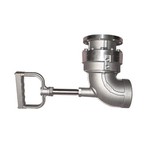
Application Scope of Pneumatic Mobile Ladders for Loading Arms
Pneumatic mobile ladders for loading arms are designed to adapt to diverse industrial scenarios and operational requirements, leveraging their automatic operation, safety features, and flexibility. Below is a detailed breakdown of their applicable fields and usage scenarios:

1. Petrochemical and Oil & Gas Industry
Core Application Scenario: Tanker loading/unloading operations in refineries, petrochemical plants, oil terminals, and storage depots.
Specific Applications:
Enables operators to safely access the top of oil tankers, chemical tankers, or LPG carriers for connecting/disconnecting loading arms.
Suitable for handling volatile, flammable, or toxic media (e.g., gasoline, diesel, solvents, liquefied petroleum gas), where hermetic operations and safety are critical.
Compatible with both top-loading and bottom-loading systems, adapting to different tanker configurations.
2. Chemical Logistics and Transportation
Use Cases:
Loading/unloading operations at chemical logistics parks, distribution centers, or transportation hubs.
Handling of corrosive chemicals (e.g., acids, alkalis), high-viscosity liquids (e.g., resins), or low-temperature media (e.g., liquid nitrogen) that require specialized access equipment.
Advantage: Reduces manual contact with hazardous media, enhancing operator safety during loading/unloading.
3. Energy and Utilities Sector
Applications:
Access for operations on fuel tanks in power plants (e.g., diesel storage tanks for emergency generators).
Maintenance and inspection of large storage vessels in natural gas processing plants or LNG terminals.
Key Requirement: Meets explosion-proof standards (e.g., ATEX/IECEx) for use in hazardous areas.
4. Industrial Manufacturing and Warehousing
Non-Chemical Scenarios:
Warehouse stacking and loading/unloading of high-position cargo (e.g., containers, bulk materials).
Access for maintenance of tall equipment in factories (e.g., reactors, towers, conveyors).
Features Utilized: Mobility via bottom rollers and adjustable height, enabling quick positioning in large workshops or warehouses.
5. Construction and Infrastructure Projects
Temporary Access Solutions:
Construction sites requiring temporary bridges or walkways for workers to cross gaps (e.g., between buildings, over trenches).
Maintenance of elevated structures (e.g., bridges, overpasses, stadium roofs), where flexible access is needed.
Benefit: Portable design allows easy relocation across different construction zones.
6. Aviation and Aerospace Support
Specialized Applications:
Fueling operations for aircraft at airports (e.g., connecting fuel hoses to aircraft tanks).
Access to rocket fuel tanks or satellite payload compartments during ground maintenance.
Requirement: Compliance with aviation safety standards (e.g., static electricity grounding, fire prevention).
7. Marine and Port Facilities
Maritime Applications:
Loading/unloading of cargo ships at ports, especially for liquid bulk goods (e.g., edible oils, chemicals).
Access to decks or cargo holds for inspection or maintenance.
Design Adaptations: Corrosion-resistant materials (e.g., stainless steel) to withstand marine environments.
8. Municipal and Environmental Engineering
Urban Applications:
Access to sewage treatment plant tanks or chemical dosing systems.
Maintenance of elevated pipelines or storage tanks in water treatment facilities.
Safety Focus: Non-slip surfaces and fall protection systems for wet or slippery environments.
Operational Limitations and Considerations
Environmental Constraints: Not suitable for extreme temperatures (e.g., < -40°C or > 120°C) without specialized modifications.
Space Requirements: Requires sufficient clearance for ladder extension (typically 1–3 meters of lateral movement).
Regulatory Compliance: Must adhere to local safety codes (e.g., OSHA in the U.S., CE standards in Europe) and industry-specific regulations.
By matching the ladder's design to the operational environment, users can maximize safety, efficiency, and durability across diverse industrial applications.