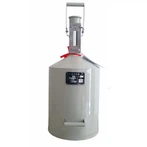
the safety technologies associated with skid-mounted refueling units.
Skid-mounted refueling units are convenient and cost-effective, making them highly popular among enterprises; however, due to a lack of professional safety management, their operation often presents various issues. The following discussion is dedicated to exploring the safety technologies associated with skid-mounted refueling units.
A skid-mounted refueling unit is defined as a ground-based refueling assembly in which equipment-such as fire-resistant and explosion-proof fuel tanks, fuel dispensers, and automatic fire suppression systems-along with their associated accessories, are integrated onto a single steel skid structure. A skid-mounted vehicle refueling station is, by definition, a vehicle refueling station that utilizes such a skid-mounted refueling unit.
I. Technical Requirements for Fuel Tanks
1. Skid-mounted refueling units shall be supplied as complete, integrated assemblies. If manufactured in accordance with Chinese national standards, these units must possess both explosion-proof and fire-resistant capabilities. They shall utilize double-walled steel fuel tanks, and the interstitial space between the inner and outer tank walls must be equipped with a leak detection device capable of detecting leaks occurring at any point within the inner tank.
2. The fuel tanks within a skid-mounted refueling unit shall incorporate the following explosion-protection measures:
1) The design pressure of the inner tank shall be no less than 0.8 MPa.
2) Explosion-protection devices (or materials) shall be installed within gasoline tanks or their respective compartments. When utilizing barrier-type explosion-protection devices (or materials), their selection and installation must comply with the relevant provisions of Chinese national standards; specifically, the pressure rise resulting from a deflagration event within such devices (or materials) shall not exceed 0.05 MPa. Should alternative explosion-protection devices be employed, their safety and necessity must be substantiated through rigorous technical demonstration and assessment.
3. The construction of the inner tank shall strictly adhere to the relevant provisions of Chinese national standards.
4. The outer tank is typically designed for atmospheric pressure; its construction shall comply with the relevant provisions of Chinese national standards. No void space capable of allowing the accumulation of oil vapors shall exist between the outer tank and its protective layer. 5. The oil tank shall be equipped with a liquid level gauge and an overflow prevention valve. The liquid level gauge shall emit an alarm signal when the liquid level inside the tank rises to 90% of the tank's capacity, and the overflow prevention valve shall close automatically when the liquid level rises to 95% of the tank's capacity. An emergency pressure relief device shall be installed; the opening pressure of this device should preferably be between 20 kPa and 30 kPa. Measures for thermal insulation or sun protection shall be implemented, and the insulation materials used must be non-combustible. Top-entry filling methods shall be employed, with the inlet pipe extending into the tank to a point between 50 mm and 100 mm above the tank bottom. If the inlet pipe connection is located at the bottom, the highest point of the inlet pipe run must be positioned above the tank's maximum liquid level, and anti-siphoning measures shall be applied to the inlet pipe. The connectors for the oil unloading hoses shall be of the self-closing quick-connect type.
6. The inlet of the oil tank's outlet pipe should preferably be positioned 150 mm above the tank bottom, and the highest point of the outlet pipe run must be positioned above the tank's maximum liquid level. Any piping and associated components connected to the inner tank shall have a design pressure no lower than that of the inner tank itself. Areas below the tank's maximum liquid level that contain connection flanges or quick-connect couplings shall be equipped with measures to contain potential oil leaks.
7. The outlet of the tank's vent pipe shall be positioned at least 4 meters above the surrounding ground level and at least 1.5 meters above the tank roof; the outlet shall be fitted with a flame arrester and a breather valve. The operating positive pressure of the breather valve should preferably be between 2 kPa and 3 kPa, while the operating negative pressure should preferably be between -1.5 kPa and -2 kPa.
8. The oil tank and pump assembly shall undergo pressure testing. The pressure testing of the inner tank shall comply with the relevant provisions of applicable Chinese standards, and the pressure testing of the outer tank shall likewise comply with the relevant provisions of applicable Chinese standards.
II. Technical Requirements for Fuel Dispensers
1. The cabinet housing the fuel dispenser and oil pump shall be designed to facilitate natural ventilation and shall not contain any structural features that allow for the accumulation of oil vapors.
2. An automatic fire extinguisher shall be installed directly above the fuel dispenser; the activation temperature of this automatic extinguisher shall not exceed 95°C. The fuel dispenser shall comply with the relevant provisions of applicable Chinese standards; dispensers located within hazardous (explosion-risk) zones shall be equipped with appropriate explosion-protection measures, and an automatic oil shut-off valve shall be installed on the fuel inlet piping. 3. Fueling nozzles shall be of the self-sealing type; the flow rate of gasoline fueling nozzles shall not exceed 50 L/min. A safety breakaway valve shall be installed on the fueling hose.
III. Technical Requirements for Scale and Site Selection: 1. The total capacity of the fuel tanks at a skid-mounted vehicle fueling station shall comply with the following provisions:
1) When located within a city center district, the total tank capacity shall not exceed 10 m³. 2) When located within a built-up urban area, the total tank capacity shall not exceed 20 m³. 3) When located in other areas, the total tank capacity shall not exceed 40 m³. 4) The capacity of diesel tanks may be calculated at half value when contributing to the total tank capacity.
2. When the capacity of a single gasoline tank exceeds 10 m³, internal compartments shall be provided within the tank, and the capacity of each compartment shall not exceed 10 m³. When the capacity of a single diesel tank exceeds 20 m³, internal compartments shall be provided within the tank, and the capacity of each compartment shall not exceed 20 m³.
3. Skid-mounted vehicle fueling stations shall be constructed as independent facilities. The safety clearance distance between the skid-mounted fueling unit and any buildings or structures located outside the station premises shall not be less than the values specified in the table below.
IV. Other Technical Requirements
1. Skid-mounted fueling units shall not be installed indoors or within other enclosed cabinets containing a vapor space. They shall be equipped with both unloading vapor recovery systems and fueling vapor recovery systems. The top surface of the unit's foundation shall be elevated 0.2 m to 0.3 m above the surrounding ground level. Anti-collision barriers shall be installed on the side adjacent to vehicle traffic lanes, and a containment bund (dike) constructed of impermeable, non-combustible solid materials shall be provided around the entire perimeter.
2. The design of the power supply and distribution system, alarm system, emergency shut-off system, lightning protection facilities, and anti-static facilities for the skid-mounted fueling unit shall comply with all applicable safety regulations. 3. The placement of fire extinguishers shall comply with the following provisions:
For every two fuel dispensers, no fewer than two 5 kg portable dry powder fire extinguishers-or one 5 kg portable dry powder fire extinguisher and one 6 L foam fire extinguisher-shall be provided; if there are fewer than two fuel dispensers, the provision shall be based on a count of two; there shall be no fewer than one trolley-mounted dry powder fire extinguisher, with a dry powder extinguishing agent capacity of no less than 35 kg; furthermore, there shall be no fewer than two fire blankets and no less than 2 m³ of sand.