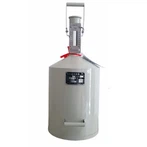
Regarding the DN500 "emergency pressure relief manhole" shown on your P&ID-was it actually calculated, or was it simply copied from someone else's drawing? Is such an "emergency pressure relief manhole" required for every storage tank? Is it intended for fire scenarios, or for cases where the nitrogen blanketing valve fails?

I. The Conclusion First
An emergency pressure relief manhole is not something "every tank should have"; it is a safeguard specific to nitrogen-blanketed tanks. According to GB 50160-2018 (Section 6.2.19) and SH/T 3007-2014 (Section 5.1.5), such devices are required only for "storage tanks containing Class A-B or Class B liquids that utilize nitrogen blanketing or gas blanketing."
In terms of pressure hierarchy, it sits above the breather valve but below the tank's design pressure: its opening pressure must be higher than the breather valve's venting pressure, yet it must not exceed the tank's design positive pressure (as per SH/T 3007, Section 5.1.5a).
Some tanks feature a "weak-roof" design, which can provide protection during a fire scenario; however, because the cost of such a design is often prohibitively high, it is standard practice to calculate the required emergency venting capacity for external fire scenarios-following API 2000 guidelines-and verify that the relief manhole provides sufficient venting area.
II. What Exactly Is It?
An "emergency pressure relief manhole"-referred to in various standards as an "emergency pressure relief device," "emergency relief manhole," or "emergency relief valve"-is one and the same. It does not belong to the same category as breather valves, single-acting pressure-relief valves, or hydraulic safety valves; rather, it serves as the final line of defense:
Breather valve: Manages routine "breathing" (inhalation/exhalation) caused by filling operations or temperature fluctuations; it operates continuously.
Single-acting pressure-relief valve: Allows only venting (exhalation) and prevents air intake (to avoid the risk of internal combustion).
Hydraulic safety valve: Used in cold climates to prevent freezing, or as a backup to the breather valve.
Emergency pressure relief manhole: Acts as a "fail-safe" (a final burst-type safeguard) when the aforementioned devices are overwhelmed; it vents exclusively to the atmosphere.