
Operation Regulations for Asphalt Loading with Loading Arms
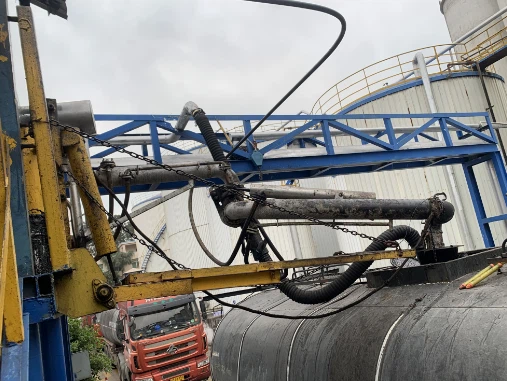
In recent years, the transportation industry has maintained a good momentum of continuous and healthy development. Road construction has witnessed rapid progress, with historic breakthroughs achieved in both expressway construction and the construction of rural and urban roads, becoming an important driving force for economic and social development. Developing road construction not only improves transportation capacity but also plays a significant role in aspects such as improving the investment environment and optimizing the industrial layout. With the rapid development of road construction, the domestic market has an increasing demand for asphalt storage and transportation equipment, with higher requirements for their performance.
Currently, in China, the top - unloading process is adopted for unloading asphalt from asphalt tank trucks, that is, loading arms are used for the loading and unloading of liquid oil. A loading arm is composed of seamless steel pipes or aluminum pipes together with swivel joints. However, the current swing arm type of loading arms mainly has the following problems: manual operation of the swing arm is time - consuming and labor - intensive, the swinging operation is cumbersome, and there are safety hazards when multiple people hold the loading arm for docking. To prevent safety problems, we must strictly comply with the operation regulations.
After receiving the asphalt loading task, operators at the heavy oil loading platform must wear labor - protection supplies. First, turn on the steam tracing of the asphalt loading arm and open the manual return valve on the asphalt return pipeline.
After the oil - loading vehicle entering the storage enters the heavy oil loading platform, the operator shall assist in guiding the vehicle to park in the proper position and turn off the engine. Then, the loading supervisor shall check the vehicle condition (whether there is water and impurities at the bottom of the tank car, whether the valve is closed, whether the flame arrester is fastened tightly, whether the vehicle has applied the handbrake, etc.) to ensure that the vehicle is in good condition and the tank is clean.
The operator shall verify the bill of lading as required, make correct records, check the vehicle number, and adjust the position of the loading arm accurately.
The driver shall open the cover plate of the oil - loading port of the tanker and assist the operator on the tanker in aligning the loading arm.
The operator shall operate the manual control air valve on the pneumatic control console of the loading arm to align the vertical pipe with the tank mouth of the tanker and insert it into the tank mouth of the tanker.
Open the loading valve at the loading position of the loading arm and notify the dispatcher to start the pump for oil loading.
On the one hand, based on the quantity indicated on the bill of lading, the operator shall estimate how many minutes the pump needs to run and notify the driver in advance. On the other hand, the operator shall require the driver to carefully observe the oil - loading situation at a safe position on the tanker (the operator shall inform the driver of the oil - loading vehicle entering the storage). When the asphalt is loaded to the safe height, the operator shall be notified in time to close the loading valve to prevent oil overflow.
In case of oil overflow, the operator shall immediately activate the emergency plan for handling and report to the superior in a timely manner.
After the loading is completed, operate the loading arm to return it to the appropriate position before loading, notify the dispatcher to stop the pump, and close the air source switch and the steam tracing of the loading arm.
Make various records.
All of the above points are very important. For our safety, it is hoped that everyone can operate in a standardized manner during the loading work!


