What is the working principle of an unloading arm?
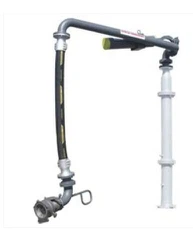
Unloading arm, also known as a loading arm or transfer arm, is a critical piece of equipment widely used in industries such as petroleum, chemical engineering, food processing, and logistics to transfer liquids or gases between storage tanks (e.g., tank trucks, railcars, or ships) and fixed storage facilities (e.g., ground tanks or processing plants). Its design integrates mechanical flexibility, structural stability, and sealing performance to ensure efficient, safe, and environmentally friendly material transfer. To understand its working principle, it is essential to explore its structural components, operational processes, and key functional mechanisms.
First, the structural composition of an unloading arm lays the foundation for its working principle. Typically, an unloading arm consists of several core components: a fixed base, swivel joints, telescopic or articulated arms, a counterweight system, a sealing device, and a terminal connector (e.g., a flange or a quick-connect coupling). The fixed base anchors the arm to the ground or a platform, providing a stable support point. Swivel joints, often made of high-strength alloys with precision bearings, allow rotational movement in multiple axes (usually 360 degrees horizontally and a certain range vertically), enabling the arm to adjust its position flexibly to align with the outlet of the mobile tank. The telescopic or articulated arms, which are hollow pipes, form the main flow channel for the medium; their length can be adjusted to accommodate different distances between the fixed facility and the mobile tank. The counterweight system, usually composed of weights or springs, balances the weight of the arm, reducing the force required for manual or mechanical operation and ensuring smooth movement. The sealing device, including gaskets, O-rings, or mechanical seals made of materials resistant to corrosion, high temperature, and pressure (such as PTFE or nitrile rubber), prevents leakage at connection points, which is crucial for handling hazardous or volatile substances. The terminal connector ensures a secure and tight connection with the tank's outlet, often designed to match standard interfaces of tank trucks or railcars.
The working principle of an unloading arm revolves around the coordinated operation of these components to achieve safe and efficient medium transfer. The process can be divided into several key stages: positioning, connection, transfer, disconnection, and resetting.
In the positioning stage, the operator (or an automated system) adjusts the unloading arm to align with the outlet of the mobile tank. Thanks to the swivel joints and telescopic arms, the arm can be maneuvered horizontally and vertically to reach the exact position of the tank's discharge port. For example, when unloading from a tank truck, the arm may need to extend outward, lift, or rotate to match the height and angle of the truck's outlet, which can vary depending on the truck's model and loading condition. The counterweight system plays a vital here, as it offsets the weight of the arm, making it easy to move even when fully extended, reducing operator fatigue and ensuring precise positioning.
Once positioned correctly, the next stage is connection. The terminal connector of the arm is securely attached to the tank's discharge port. This connection must be tight to prevent leakage, especially when handling flammable, toxic, or corrosive substances. Depending on the application, the connection may be achieved via flanges bolted together, quick-connect couplings that lock into place with a simple lever action, or other specialized fittings designed for specific media. During this process, the sealing device comes into play: the gaskets or seals compress between the connecting surfaces, creating a hermetic seal that prevents the medium from escaping into the environment.
With the connection established, the transfer stage begins, which is the core of the unloading arm's operation. The medium (liquid or gas) flows from the mobile tank to the fixed storage facility through the hollow arms of the unloading arm. The driving force for this flow is typically provided by one or more of the following: gravity, pressure differential, or pumps. In some cases, the mobile tank may be elevated, allowing the medium to flow downward into the fixed tank by gravity. In other scenarios, the mobile tank may be pressurized, creating a pressure differential that pushes the medium through the arm. For viscous liquids or when longer transfer distances are involved, pumps are often used to actively move the medium through the arm. The design of the arm's internal diameter and the smoothness of its inner surface are critical here, as they minimize flow resistance and ensure a steady transfer rate. Additionally, some unloading arms are equipped with flow meters or control valves to monitor and regulate the flow rate, allowing operators to adjust the transfer speed as needed to prevent overflow or excessive pressure buildup.
During the transfer process, several safety mechanisms work in tandem to ensure operational integrity. Pressure relief valves are installed to release excess pressure if it exceeds safe limits, preventing damage to the arm or the tanks. Emergency shutdown systems (ESDs) are also common; these can be triggered manually or automatically (e.g., in the event of a leak, excessive pressure, or a sudden movement of the mobile tank) to stop the flow immediately and close isolation valves, minimizing the risk of spills or accidents. Furthermore, the materials used in the arm's construction are carefully selected based on the properties of the medium: for example, arms handling corrosive chemicals are made of stainless steel or other corrosion-resistant alloys, while those handling food-grade materials are constructed from materials that meet hygiene standards (e.g., polished stainless steel with no crevices where bacteria can accumulate).
Once the transfer is complete, the disconnection stage begins. The flow is stopped, and any residual pressure in the arm is relieved to ensure safe disconnection. The terminal connector is then detached from the tank's discharge port, and the arm is cleaned if necessary (especially for food-grade or high-purity applications) to prevent contamination during subsequent use.
Finally, the resetting stage involves moving the arm back to its stowed position, typically close to the fixed base, to keep it out of the way when not in use and protect it from damage. The counterweight system assists in this process, making it easy to retract the arm even when it is empty.
It is important to note that the working principle of unloading arms can vary slightly depending on their specific design and application. For example, marine unloading arms (used to transfer liquids between ships and shore facilities) are often larger and more robust, with additional swivel joints to accommodate the movement of the ship due to waves and tides. In contrast, railcar unloading arms may be designed to handle lower flow rates and have a more compact structure to fit within the constraints of rail yards. Similarly, arms used for hazardous materials may have enhanced sealing and safety features, such as double-walled construction to contain leaks, or vapor recovery systems to capture volatile organic compounds (VOCs) and prevent them from escaping into the atmosphere.
The working principle of an unloading arm is a sophisticated integration of mechanical movement, fluid dynamics, and safety engineering. By combining flexible positioning, secure connection, efficient fluid transfer, and robust safety mechanisms, unloading arms enable the safe, efficient, and environmentally responsible transfer of liquids and gases between mobile and fixed storage facilities, playing a crucial role in numerous industrial and logistical operations.
For more information about loading arm, please don't hesitate to contact us. Thank you.