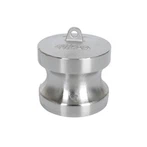
At sites where hazardous chemicals are loaded or unloaded, the breakaway coupling-installed on loading arms or hoses-serves as a critical safety barrier. It is designed to automatically disconnect when a vehicle pulls away unexpectedly and the applied force exceeds a preset threshold. Upon disconnection, both ends seal shut, preventing the large-scale release of hazardous chemicals and averting major incidents such as fires, explosions, or toxic exposure. However, during on-site inspections, we frequently encounter a highly deceptive issue: a breakaway coupling may appear correctly installed and in good condition, yet the factory-supplied "safety bolt" (intended for transport protection) has never been removed. Having remained in place for years, this bolt renders the coupling incapable of breaking away as intended should a vehicle accidentally pull off-effectively turning a vital safety device into a useless piece of hardware.
(See image of a breakaway coupling at the end of this article.)
I. Why does this safety bolt exist?
A breakaway coupling is a safety component. During factory production, long-distance transport, and on-site lifting or installation, its internal, intentionally weakened structure could be triggered prematurely by vibrations or impacts. Manufacturers provide a temporary "safety bolt" to lock the coupling in place during transit and installation, preventing accidental activation. It is a temporary fixture, not a functional part for operational use.
Many facility personnel are unfamiliar with the operating principles of breakaway couplings and mistakenly believe this bolt is a permanent structural fastener. Consequently, it is left in place after installation-sometimes remaining for years after the equipment has been put into service. It is often absent from equipment registers and daily inspection checklists; operators and team leaders may not even be aware of its existence.
II. How significant is the risk when operating with the bolt still in place?
A common risk during the loading or unloading of hazardous chemicals occurs when a driver inadvertently starts the vehicle and pulls away before the process is complete. Alternatively, a vehicle might roll-perhaps because the driver failed to engage the parking brake or neglected to use wheel chocks-thereby exerting tension on the loading arm or hose. Under proper operating conditions, once the tension reaches the coupling's rated breakaway force, the unit should fracture, and both ends should automatically seal, preventing any leakage of the hazardous material. If the safety-securing bolt remains in place, it effectively renders the designated "weak point" rigid. Consequently, the intended breakaway mechanism cannot be triggered by tensile force. Under continued tension, the equipment will not function as designed; instead, it may lead to the deformation of loading arms, the tearing of hoses, the failure of pipeline flanges, or damage to pump or storage tank connections. This can result in the instantaneous, massive release of flammable, explosive, or toxic hazardous chemicals. The dispersion of combustible vapors-if exposed to an ignition source-can easily trigger fires or explosions, while toxic substances may cause acute poisoning among personnel. A safety device intended to mitigate loss is thus rendered completely ineffective due to a single, small bolt.
What makes this hazard particularly insidious is its "static" and "hidden" nature. During routine loading and unloading operations, everything may appear normal, with no visible signs of an issue-meaning it can easily go unnoticed during daily visual inspections. The failure is only discovered when an accident occurs and the breakaway valve fails to activate, often with devastating consequences.
III. What Should Enterprises Do?
1. Mandatory Inspection During Installation and Acceptance. Before a breakaway valve is put into formal service, a joint inspection by equipment and safety personnel must be conducted. This process must verify that the temporary factory-installed safety bolts have been removed. Records of this inspection must be maintained; under no circumstances should equipment be placed into operation while these temporary bolts are still attached.
2. Inclusion in Routine Inspections and Periodic Maintenance. The condition of the breakaway valve-including its external appearance, the absence of any remaining temporary bolts, the integrity of the valve body (checking for deformation or corrosion), and the state of its seals-should be incorporated into routine inspection checklists. Furthermore, calibration and verification documentation for the valve should be periodically reviewed to ensure it continues to meet its rated breakaway force specifications.
3. Comprehensive Staff Training and Briefing. Specialized training should be provided to personnel involved in loading and unloading operations, drivers, and equipment maintenance staff. This training must clearly explain the operating principle of the breakaway valve and the purpose of the temporary safety bolts-emphasizing that these are strictly for transport and installation, and must be removed before the equipment is put into service-thereby eliminating any potential gaps in understanding.
4. Enhancement of Loading and Unloading Operational Controls. During loading and unloading operations, strict measures must be implemented to prevent accidental vehicle movement. This includes the use of wheel chocks, ensuring the engine is turned off and the parking brake is engaged, and maintaining on-site supervision. These steps mitigate the risk of accidental vehicle pull-away at the source, providing a dual layer of protection alongside the emergency breakaway valve.

IV. Safety Reminder
Installing safety equipment is not the final step; its protective function can only be truly realized when personnel understand its operating principles, know how to maintain it, and ensure it is used in accordance with its design specifications. For instance, leaving a small, temporary safety bolt in place for an extended period can render a safety device entirely ineffective. It is urged that all enterprises involved in the loading and unloading of hazardous chemicals conduct targeted inspections-reviewing all loading arms and emergency breakaway valves on hoses-to promptly eliminate such hidden hazards and uphold the fundamental safety standards for hazardous chemical handling.