
Common Sealing Methods for Loading Arms
First, let's review the regulations on loading arm sealing. For example:
Code for Design of Oil Vapor Recovery Facilities in Oil Loading Systems (GB50759-2012) Clause 3.0.1: "Loading systems for gasoline, naphtha, aviation kerosene, solvent oil, or similar oils shall be equipped with oil vapor recovery facilities."
Clause 5.1.4: "The connection between the loading arm and tanker shall be tight, without oil vapor leakage."
Atmospheric Pollutant Emission Standard for Oil Storage Facilities (GB20950-2007) Clause 4.1: "…Requires that oil vapor generated during loading shall be hermetically collected and recovered."
Clause 4.2: "The volume fraction of oil vapor emitted from any leakage point in the closed oil vapor collection system shall not exceed 0.05%... (probe 25mm from the leakage point, moving at 4cm/s)."
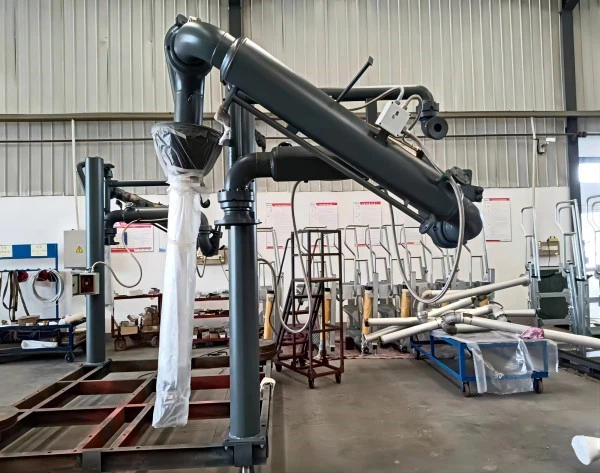
These standards mandate that loading arms must be sealed to prevent leakage, ensuring worker safety, equipment protection, and environmental compliance. Below are several common sealing methods for loading arms:
1. Mechanical Sealing
Mechanical sealing is a common method for loading arms, utilizing two relative moving sealing surfaces (dynamic ring and static ring) that fit together, forming an extremely thin liquid film on the joint surface to achieve sealing. The main leakage points of mechanical seals include five areas:
Seal between the shaft sleeve and shaft
Seal between the dynamic/ static ring and shaft sleeve
Seal between the dynamic and static rings
Seal between the static ring and its seat
Seal between the sealing end cover and pump body
These sealing points primarily use sealing elements such as PTFE gaskets, O-rings, or bellows.
2. Plate-Type Sealing Cap Sealing
For closed loading arms of railway tank cars, plate-type sealing cap sealing is a common method. The sealing cap is pressed tightly by cylinder power to fit closely with the tank car opening, meeting the requirements of closed loading. The pressing power structures include multiple forms:
Axial pressing force provided by the self-weight of the sealing cap
Axial stress directly applied by the cylinder on the top of the sealing cap
Axial tension provided by cylinder-linked three-claw hooks leveraging the inner wall of the tank car
However, closed loading arms with three-claw hook structures have a high failure rate in daily use, so more reliable sealing methods may need to be considered in practical applications.
3. Airbag Expansion Sealing
Aiming at the problems of three-claw hook-type sealing devices, an improved solution proposes transforming the sealing device into a system with minimal alignment requirements, using an air source to inflate an airbag for sealing on the straight pipe section of the tank car opening. This method reduces the use of transmission systems like three-claw hooks, simplifies operation procedures, and enhances the flexibility and tightness of the sealing system through inner sealing, preventing oil splashing and the formation of explosive flammable gases.
4. Other Sealing Methods
In addition to the above common methods, loading arms may also adopt other sealing methods, such as magnetic sealing and packing sealing. Each of these methods has unique characteristics, suitable for different scenarios and medium properties.
Conclusion
Loading arms employ a variety of sealing methods. The specific choice should be comprehensively considered based on factors such as loading arm design, application scenarios, and medium characteristics. In practical applications, the effectiveness and reliability of the sealing method must be ensured to safeguard production safety and environmental protection.


