What are the characteristics of the drop tube in a loading arm?
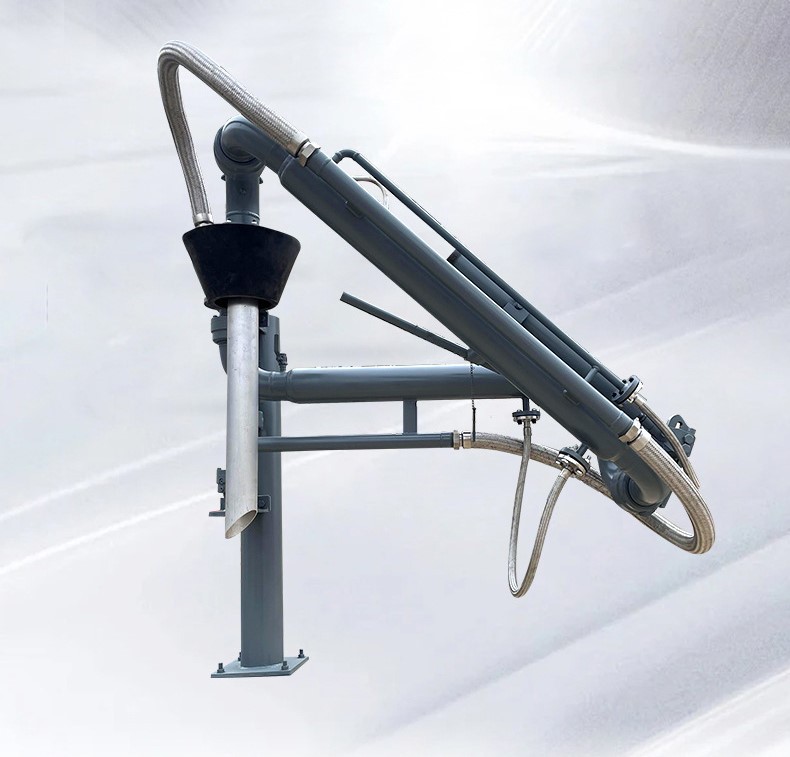
The drop tube is a critical component located at the end of a loading arm that extends into the tank's opening. Its primary purpose is to ensure safe, efficient, and environmentally compliant transfer of liquids, especially volatile products. Its key characteristics include:
Telescopic Design: Most modern drop tubes are telescopic. This allows them to be lowered close to the bottom of the tank (ideally within 200 mm or less of the tank floor) to minimize splashing and submerged loading. They retract for easy docking and undocking from the vessel.
Material Composition: They are constructed from materials resistant to corrosion and the specific chemicals being handled. Common materials include:
Stainless Steel (e.g., 304, 316L): For corrosion resistance in a wide range of products.
Aluminum: For use in aviation fuel loading to prevent sparking.
Carbon Steel with Special Coatings: For abrasive or specific chemical services.
Safety and Vapor Control:
Submerged Loading: The primary function is to enable bottom loading, which drastically reduces the generation of static electricity and the release of volatile organic compounds (VOCs) into the atmosphere.
Vapor Recovery Compatibility: Many drop tubes are part of a closed-loop system, featuring a vapor recovery collar that captures displaced vapors and returns them through a separate hose or arm.
Static Electricity Dissipation: Drop tubes are designed to be intrinsically grounded as part of the loading arm system. Materials and construction methods are chosen to prevent the build-up of static charge, which is a critical ignition hazard.
Lightweight and Durable Construction: They are often made from lightweight alloys or composites to make manual or automated handling easier for the operator, while still being robust enough to withstand operational wear and tear.
End Configuration: The bottom of the tube may have a specific design, such as a flared end or a deflector plate, to control the flow of liquid and prevent it from impinging directly on the tank bottom, which could stir up sediments or create excessive turbulence.
In summary, the drop tube is engineered to enhance safety, improve environmental protection, and increase operational efficiency during the transfer of liquids into tanks and vessels.