Comprehensive Selection Guide for Storage Tank Overfill Prevention Sensors (Petrochemical & Hazardous Chemical Tank Farm Compliance Edition)
I. Establish the Mandatory Regulatory Baseline (Primary Prerequisite for Selection)
1. Key Domestic Standards
GB 17681-2024 *Technical Specification for Safety Monitoring of Major Hazard Installations of Hazardous Chemicals*
Atmospheric storage tanks for combustible liquids: 2 sets of continuous level instruments OR 1 continuous level gauge + 2 independent "High-High" level switches; the "High-High" level signal must be interlocked with the emergency feed shut-off valve and integrated into the Safety Instrumented System (SIS).
SH/T 3007-2014 *Code for Design of Tank Farm for Petrochemical Storage and Transportation Systems*
"High-High" alarm level ≤ 90% of total tank capacity; large storage tanks (≥3,000 m³) require redundant level monitoring using dual measurement principles; level sensing ports/nozzles must be independent and cannot share the same connection pipe.
SH/T 3184-2017, AQ 3036-2010
Light oils: Radar, servo, or magnetostrictive technologies preferred; heavy oils/viscous media: Radar or fiber-optic level switches preferred; overfill alarm accuracy ≤ ±5%. 2. International Storage and Transport Standards (Foreign Trade / Overseas Projects)
API STD 2350: Overfill Prevention for Road/Rail Loading and Unloading:
Overfill prevention systems are categorized into three types:
Point-level switches (alarm only; tuning fork type commonly used)
Continuous level gauges (process monitoring + overfill early warning)
ATG Automatic Tank Gauging Systems (fully automated overfill prevention interlocks for unmanned tank farms)
II. Step One: Selection based on measurement function (two main overfill prevention solutions)
Solution A: Single-point "High-High" overfill switch (core of SIS interlock; mandatory redundancy)
Detects only the critical "High-High" overfill threshold; serves as a hard-wired safety interlock; offers highest reliability; standard equipment for tank farms.
Tuning fork level switch (Preferred choice)
✅ Advantages: Unaffected by foam, surface turbulence, air bubbles, or minor material buildup; full range of explosion-proof ratings; response time <1s; high temperature and pressure resistance; suitable for petroleum products, chemical solvents, and wastewater; can be configured for dual-point protection (dry-run prevention + overfill prevention).
❌ Limitations: Single-point detection only; cannot provide continuous level indication.
Applications: Gasoline/diesel/methanol/ethylene glycol; thermal oil storage tanks; overfill prevention for loading arms; SIS "High-High" interlocks.
Capacitive level switch
✅ Suitable for viscous media, crystallizing media, and non-contact detection via external mounting on non-metallic tank walls.
❌ Requires periodic calibration due to changes in medium dielectric constant; prone to false triggering from oily buildup on walls.
Photoelectric level switch
Compact size, micro-thread mounting; suitable only for clean, low-pressure, light petroleum products; poor high-temperature resistance; prone to obscuration by oil residue; rarely used as the primary overfill prevention device in tank farms.
Float-type level switch
Lowest cost; mechanical structure; prone to jamming with viscous heavy oils or media containing impurities; strictly prohibited for primary overfill protection on tanks containing flammable/explosive hazardous chemicals; used only for auxiliary alarms. Option B: Continuous Level Transmitter (Early Overflow Warning + Routine Metering)
Provides real-time level output and predicts remaining capacity; displays data on the DCS; includes a "High-High" alarm output and pairs with a single-point switch to form a redundant anti-overflow system.
FMCW Radar Level Gauge (Primary choice for tank farms)
Non-contact, top-mounted design; no contact with the medium and no mechanical wear; stable performance amidst foam, steam, high temperatures, and viscous crude oil or residual oil; suitable for large dome-roof tanks with ranges up to 70m; supports HART and 4-20mA protocols; capable of outputting trigger signals for "High-High" overflow limits.
Guided Wave Radar (TDR/GWR)
Suitable for small-diameter tanks, highly viscous or high-pour-point oils, and pressurized liquefied hydrocarbon tanks; offers higher accuracy than non-contact radar.
Magnetostrictive Level Gauge
Extremely high accuracy (±0.5mm); suitable for horizontal pressurized storage tanks and LPG/LNG pressure vessels; side-mounted via flange; provides multi-point level output.
Servo Level Gauge
Custody-transfer grade accuracy; standard for commercial transfer tanks; high cost; primarily used in refined product depots for commercial metering combined with overflow protection.
Final Compliant Configuration (Standard Setup)
Primary Solution (Mandatory for Major Hazard Installations): 1 Radar Continuous Level Gauge (for DCS early warning) + 2 Independent Tuning Fork Overflow Switches (for SIS dual-interlock feed valve cutoff); utilizes redundancy through two different measurement principles. III. Step 2: Verification of 7 Key Technical Parameters (Determining Service Life and Stability)
1. Medium Properties (Most Critical)
Conductive vs. Non-conductive: For oil products (insulating), prioritize tuning fork or radar; for conductive wastewater/acids/alkalis, use electrode or capacitance switches.
Viscosity: <1000 mm²/s → Tuning fork (general purpose); high-viscosity asphalt/tar → Non-contact radar.
Corrosiveness: Options include 304/316L stainless steel, Hastelloy, PTFE lining, or PVDF probes.
Coating/Build-up, Crystallization, Foaming: Select tuning fork or radar; rule out capacitance and float switches.
2. Process Temperature and Pressure
Atmospheric storage tanks: Standard models (-40 to 80°C) suffice.
Thermal oil, high-temperature heavy oil (≤250°C): High-temperature tuning fork with extended probe or high-temperature radar.
Pressurized tanks (LPG, liquid ammonia): PN16/PN25 high-pressure flanges; pressure rating must match the tank's design pressure.
3. Explosion-proof and Safety Certifications (Mandatory for hazardous chemical tanks)
Domestic: Ex d (flameproof) / Ex ia (intrinsically safe), GB3836.
Overseas export: ATEX, IECEx, UL, FM certifications.
SIS Interlock Loop: SIL2/SIL3 Safety Integrity Level certificate required (mandatory for petrochemicals).
4. Process Connection (Matching installation dimensions)
Top tank nozzle: DN50/DN80 flange (most common).
Side-wall overflow port: G2, NPT2 male thread, or BSPP thread (common for export).
Extended insertion depth: Determine probe length based on overflow alarm height; avoid inlet turbulence, internal stiffeners, and agitators.
5. Output Signal (Interfacing with control systems)
Single-point overflow switch (tuning fork):
SIS safety loop: Passive dry contact SPDT (preferred); PLC standard loop: NPN/PNP transistor output.
Continuous level gauge (radar / Magnetostrictive:
4–20 mA + HART, RS485 Modbus; configurable dual independent relay outputs for high-high level/overflow alarms.
6. Protection Rating and Environment
Outdoor tank farms: IP67/IP68-rated enclosure; resistant to rain, dust, and winter condensation; optional heat-traced housing available for low-temperature northern regions.
7. Mandatory Installation Requirements
Overflow detection point height: h = Total tank height × 90% (SH/T3007 mandatory requirement).
Install away from inlet nozzles, tank support columns, manholes, and steam purge ports to prevent false triggering caused by liquid surface turbulence.
Redundant sensor sets require separate process connections and independent piping; sharing the same pressure-sensing line is prohibited.
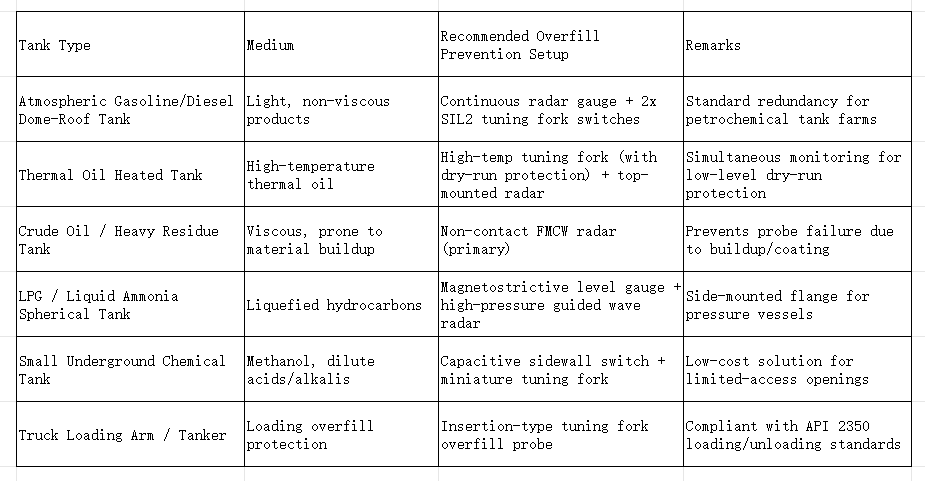
IV. Quick Selection Comparison Table for Various Storage Tank Scenarios
V. Finalizing Selection: Implementation Rules for Redundancy, Interlocks, and Acceptance
Redundancy Principle
Reliance on a single instrument for the protection of major hazard installations is strictly prohibited; instruments based on different operating principles (e.g., radar combined with tuning fork) must be used, with complete independence regarding hardware, power supply, and wiring.
Interlock Logic
High-High Level Logic: The first signal triggers a DCS audible and visual alarm; the second signal acts via a hard-wired SIS safety loop to directly cut off the feed pump and emergency shut-off valve, bypassing PLC program logic.
Ease of Maintenance
Prioritize maintenance-free designs: tuning forks require no periodic calibration; radar units support remote HART commissioning; avoid mechanical sensors-such as electrodes or floats-that require frequent disassembly and cleaning.