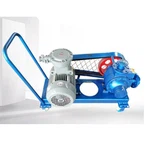
LPG Tanker Loading/Unloading Arm (Land-based Fluid Loading Arm / LPG Loading Arm)
The LPG loading/unloading arm is specialized enclosed equipment designed for high-pressure, volatile liquefied hydrocarbons. It features a standard dual-channel structure (liquid phase + vapor phase) and serves as a robust alternative to rubber hoses for the enclosed transfer of LPG between road/rail tankers and storage terminal tanks. Mainstream models include AL2543 (bottom loading) and AL1512 (top loading).
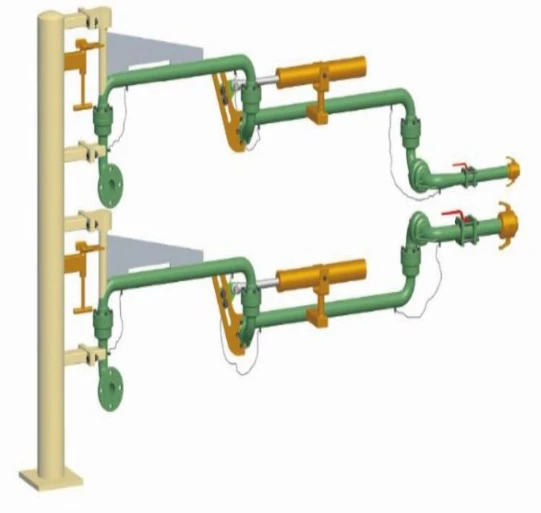
3D Model of LPG Bottom Loading Arm
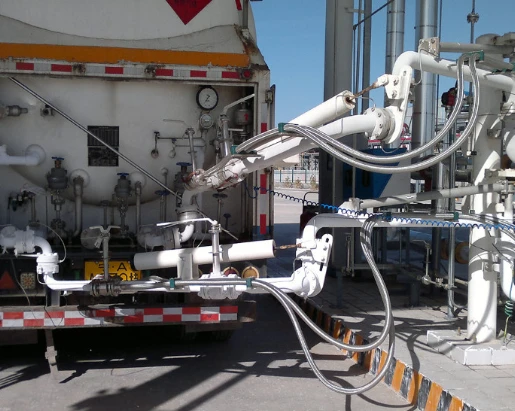
On-site Loading Operation
I. Complete Structural Composition (Two independent pipelines for vapor and liquid phases)
1. Support Column Assembly
Function: Serves as the load-bearing base for the entire unit, withstands the overturning moment of the arm assembly, and is anchored to the loading platform; houses the main swivel joint.
Configuration: Includes a locking mechanism to secure the inner and outer arms during parking, preventing swaying or collisions.
Material: Q235 carbon steel with heavy-duty anti-corrosion coating.
2. Swivel Joint (Core component; high-pressure seal specialized for LPG)
Each liquid-phase pipeline incorporates 5 swivel joints, with multiple swivel joints for the vapor-phase line;
Function: Enables 360° horizontal rotation, vertical pitching, and multi-degree-of-freedom movement to accommodate variations in tanker parking positions;
Structure: Double-row ball bearings + dual sealing system (PTFE + graphite/fluororubber combination seal);
Requirements: Pressure rating ≥ 2.5 MPa; low-temperature resistance; helium leak-tightness; strictly prohibits the use of standard swivel joints intended for general petroleum products. 3. Arm Piping (Inner Arm + Outer Arm)
Features a dual-channel parallel layout for liquid and vapor lines:
Liquid line: DN50/DN80, for transporting liquid LPG;
Vapor line: DN25/DN50, for balancing tanker pressure and recovering vaporized BOG;
Material: 304/316L stainless steel with forged fittings (ordinary carbon steel is strictly prohibited for LPG service);
Bottom-loading type: Terminal connects directly to the tanker's bottom loading/unloading port; Top-loading type: Equipped with a drop pipe extending into the tank.
4. Balancing Mechanism (Spring Balance Cylinder)
Function: Torque balancing; allows the arm to hover at any angle and enables easy positioning by a single operator;
Type: External hydraulic or spring-loaded cylinder; factory-calibrated for precise torque.
5. Front-end Connection Components (Tanker-side)
(1) Dry-type Emergency Release Device (ERC/Emergency Break-away Valve – mandatory requirement)
Automatically disconnects when a preset pulling force is reached (e.g., if the vehicle moves unexpectedly while connected); valves at both ends close simultaneously with bi-directional sealing to prevent massive LPG leakage; available in shear-pin or consumable-free mechanical types.
(2) Tanker Quick-Connect Coupling / Dry-Seal Coupling
LPG-specific metal-seal quick-connect interface; compatible with standard LPG tanker loading/unloading flanges;
Shut-off ball valves: Independent manual or pneumatic shut-off valves for vapor and liquid lines.
6. Safety Ancillary Systems (Mandatory under hazardous chemical regulations)
(1) Static Bonding Cable: Connects the loading arm, tanker, and loading platform to dissipate static electricity generated by flow;
(2) Grounding Interlock Device: Prevents the loading system pump from starting if grounding is inadequate;
(3) Purge Connection: Nitrogen purge line for displacing combustible media within the piping before and after operations;
(4) Optional: Pneumatic drive mechanism, position sensors, and ESD (Emergency Shutdown) linkage interface. II. Classification of the Two Main Types and Structural Differences
1. Bottom-loading/unloading arm (AL25xx; the mainstream choice for new LPG storage facilities)
Connection point: Bottom loading/unloading port of the tanker; all operations performed at ground level, eliminating risks associated with working at heights.
Advantages: High sealing integrity, extremely low evaporative loss, and reduced static electricity risk.
Layout: Vapor and liquid arms arranged side-by-side; the standard configuration for LPG road tankers in China.
2. Top-loading/unloading arm (AL15xx; common in older facilities or for rail tankers)
Connection point: Manhole or loading/unloading port at the top of the tanker; drop pipe extends below the liquid surface.
Disadvantages: Requires working at heights and the use of a loading gantry/platform; being gradually phased out in new projects.
III. Design Parameters (Standard LPG Operating Conditions)
Design pressure: 2.5 MPa; hydrostatic test pressure: 3.75 MPa
Design temperature: -40°C to +60°C
Applicable media: Pressurized liquefied hydrocarbons such as LPG, propane, butane, and propylene
Nominal diameter: Liquid phase DN50/DN80; vapor phase DN25/DN50
IV. Operating Principle
Deploy the loading/unloading arm and securely connect the vapor and liquid couplings to the tanker ports; establish a static grounding connection.
Loading (Facility → Tanker): Liquid LPG is transferred into the tanker via the liquid line; vapor-phase LPG displaced from the tanker is returned to the facility's storage tank via the vapor line to balance pressure and prevent over-pressurization.
Unloading (Tanker → Facility): Liquid LPG is transferred to the storage tank via the liquid line; vapor from the facility is returned to the tanker to maintain internal pressure and ensure flow.
Upon completion: Close valves at both ends, depressurize, disconnect couplings, and retract and lock the arm assembly. V. Application Scenarios
Commercial LPG storage and distribution stations: Loading and unloading of LPG road tankers;
Refineries and petrochemical parks: Loading and unloading of LPG, propane, and butane via rail or road tankers;
Fine chemical enterprises: Receipt of liquefied hydrocarbon feedstocks such as liquid propylene and isobutane;
Oil and gas gathering and transportation stations: Loading of light hydrocarbon products for outbound transport.
VI. Key Advantages over Rubber Hoses (Mandatory Requirements under Hazardous Chemical Regulations)
Rigid arm structure eliminates risks of bulging or bursting, preventing leakage caused by hose aging;
Multi-degree-of-freedom rotation ensures excellent maneuverability and eliminates torsional stress on the pipeline;
Equipped with a standard emergency breakaway valve for proactive accident protection;
All-metal construction ensures continuous static electricity dissipation;
Service life far exceeds that of rubber hoses, with longer maintenance intervals.
VII. Key Safety Precautions
Strictly prohibit the interchangeable use of LPG loading/unloading arms with those for liquid ammonia or LNG (seals, materials, and pressure ratings are incompatible);
Inspect swivel joints for leaks and check the balance cylinder for malfunction before every operation;
Purge air from the pipeline with nitrogen prior to loading or unloading;
If the breakaway valve triggers a separation, inspect the seals and reset or replace the shear pin; forced welding repairs are strictly prohibited.