How to Select a Suitable Hydrogen Peroxide Loading Arm Model
Key Consideration Factors for Model Selection
1. Medium Properties and Operational Conditions
Hydrogen Peroxide Concentration:
30% concentration: Typically choose 304 stainless steel (SS304) for general corrosion resistance.
High concentrations (>50%): Recommend 316L stainless steel for enhanced resistance to oxidative corrosion.
Temperature and Pressure Range:
Operating temperature: Ensure the loading arm materials (e.g., seals, pipes) withstand temperature fluctuations (usually -20°C to 80°C in industrial applications).
Pressure rating: Match the pipeline's pressure capacity (e.g., 1.0 MPa for gravity flow, 2.5 MPa for pump-assisted transfer).
2. Loading/Unloading Method and Installation Scenario
Bottom vs. Top Loading/Unloading:
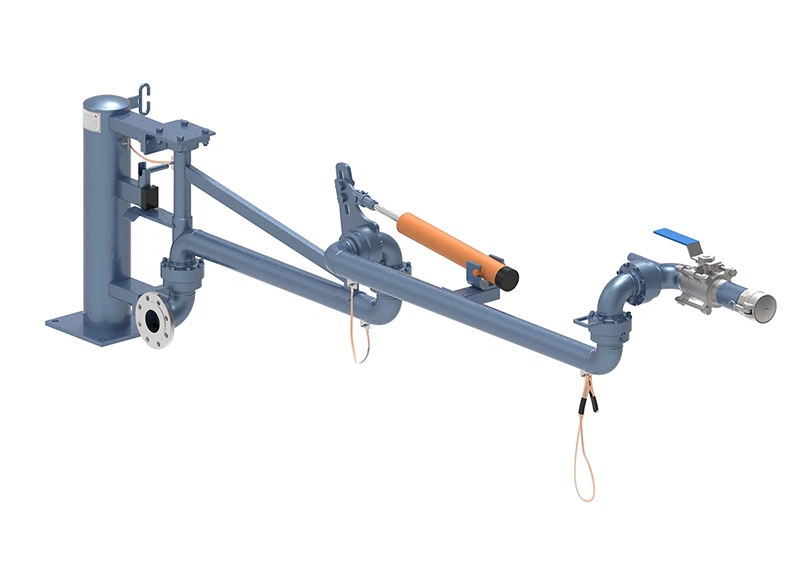
Bottom loading/unloading: The preferred method for hydrogen peroxide to reduce vapor emission. Select AL2503-type bottom closed loading arms (e.g., 2-inch or 3-inch specifications) with quick-connect fittings.
Top loading/unloading: Used only in special cases (e.g., older tank trucks), requiring AL1412-type top loading arms with vapor recovery systems.
Installation Environment:
Outdoor use: Prioritize UV-resistant seals and weatherproof stainless steel finishes.
Indoor terminals: Focus on space-saving designs (e.g., compact swivel joint configurations).
3. Safety and Compliance Standards
Explosion Prevention:
Ensure the loading arm is grounded to dissipate static electricity (critical for preventing ignition of hydrogen peroxide vapors).
Choose models certified by FM/ATEX for use in hazardous areas.
Leakage Protection:
Equip with emergency break valves (EBDVs) that automatically disconnect under ≤500N tension to prevent spills during unexpected vehicle movement.
Require double-seal designs at swivel joints (e.g., PTFE primary seals + fluororubber backup seals).
4. Flow Rate and Pipeline Specifications
Flow Capacity:
Calculate the required flow rate (e.g., 50 m³/h for large tank trucks) and select the pipe diameter accordingly (2-inch pipes support ~30 m³/h, 3-inch pipes support ~60 m³/h).
Connection Compatibility:
Ensure quick-connect fittings comply with standards like API 650 or DIN 2817, matching tank truck inlets (common sizes: DN50, DN80, DN100).
Step-by-Step Model Selection Process
1. Determine the Loading/Unloading Mode
Bottom closed loading/unloading: Recommend the AL2503 series (e.g., AL2503-316L-80) for modern tank trucks with high safety requirements.
Top open loading/unloading: Choose the AL1412 series (e.g., AL1412-304-50) for older facilities with limited bottom access.
2. Select Material Grade Based on Concentration
30% H₂O₂: Use SS304 (ASTM A240 304) for pipes and joints.
>50% H₂O₂: Opt for SS316L (ASTM A240 316L) to resist pitting corrosion.
Seal materials: PTFE (suitable for ≤60°C) or perfluoroelastomer (FFKM) for high-temperature/high-concentration scenarios.
3. Configure Safety Accessories
Mandatory accessories:
Emergency break valves (EBDVs) with automatic shut-off functionality.
Ball valves for flow control (SS316L body, PTFE seat).
Optional upgrades:
Vapor recovery adapters for environmental protection.
Integration of pressure gauges and flow meters for real-time monitoring.
4. Verify Mechanical Specifications
Rotation range: Ensure universal joints allow ≥180° vertical and 360° horizontal movement to adapt to truck positioning errors.
Weight balance: Choose models with counterweight systems (e.g., spring-loaded or pneumatic balancing) to minimize operator effort during positioning.
Common Hydrogen Peroxide Loading Arm Models and Their Features
AL2503-304: Made of SS304, with DN50/DN80 connections, a maximum flow rate of 40 m³/h, and equipped with EBDVs and PTFE seals. Suitable for general industrial use with 30% H₂O₂.
AL2503-316L: Constructed from SS316L, featuring DN80/DN100 connections, a maximum flow rate of 60 m³/h, double-seal design, and FM certification. Ideal for high-concentration H₂O₂ in chemical plants.
AL1412-316L: Made of SS316L, with a DN50 connection, a maximum flow rate of 25 m³/h, and equipped with vapor recovery ports and grounding kits. Suitable for top loading in confined spaces.
By systematically evaluating these factors, users can select a loading arm model that balances safety, operational efficiency, and long-term durability for hydrogen peroxide handling.